
In the first article of this series, I discussed how the German–French compromise on automotive brought the United Kingdom into the “Made in Europe” definition while leaving out Türkiye, the Customs Union’s partner of thirty years. In the second article, I discussed the possibility that our request to be included in this definition could be tied to a political condition through the EU’s expectation of “strategic alignment”.
On 12 November 2026, 47 organisations from the European and UK energy sector addressed a joint letter to the leaders of both sides. The letter calls for the Emissions Trading Systems (ETS) of the two sides to be linked at the EU–UK summit to be held in Brussels on 20 November, and for the resulting mutual exemption from the Carbon Border Adjustment Mechanism (CBAM) to be put into effect swiftly. The signatories include names the wind sector knows well, such as WindEurope, RenewableUK, Vestas, Siemens Gamesa, Ørsted and GE Vernova.
At first glance, this looks like a technical carbon market arrangement between two parties. But when we read it together with the previous two articles in the series, we see that, after the “Made in Europe” definition, a second door is now opening for the United Kingdom. In this article, again wearing my supplier’s hat, I will try to assess what the letter asks for, how the timetable may unfold, and what all this means for Türkiye’s wind industry.
What does the letter ask for?
The letter is addressed, on the EU side, to Commission President von der Leyen and the relevant commissioners, and on the UK side to the Prime Minister and the energy department. Its requests can be grouped under four headings.
ETS linkage and mutual CBAM exemption: The signatories expect the ETS linking agreement to be concluded at the summit and an ambitious, clear timetable to be announced for its implementation. The reasons given are the shared benefit of a larger carbon market and the removal of CBAM’s negative effects on clean energy trade.
Electricity trading: A pragmatic approach is requested to make cross-border electricity trading between the two sides more efficient. Looking at the weight of interconnector operators and transmission system operators among the signatories, it would not be wrong to say that this heading is the real driving force behind the letter.
North Seas cooperation: The letter proposes that the United Kingdom become a full member of the North Seas Energy Cooperation (NSEC) ahead of the North Sea Summit it will host in 2028. This is said to support supply chain development and reductions in technology costs.
The “trusted partner” definition: From our point of view, the most striking request comes in the final part of the letter: building on their highly integrated value chains, the EU and the UK are asked to recognise each other as trusted partners in strengthening Europe’s clean technology and grid supply chains.
There is much more in the letter than the carbon market: the largest organisations of Europe’s wind sector are pointing to the United Kingdom as a “trusted partner” in the clean technology supply chain.
When can a result be expected?
According to press reports, the negotiations have been completed and the agreement is expected to be announced at the summit on 20 November. However, between the announcement and an actual exemption there are legal steps that both sides need to complete.
The parties also have the option of applying the agreement provisionally before it enters into force. If that route is not taken, it does not seem realistic to me to expect the actual exemption to begin before the second half of 2027; no official date has yet been announced. The letter’s request for “an ambitious and clear timetable” should be read in this light: our colleagues based in the EU and the UK are concerned that the political agreement will lose time in the legal process.
Will UK industry gain a competitive advantage?
This question needs two different answers, depending on whom we are comparing with.
Compared with EU producers, it is not possible to speak of an advantage. The rationale for the exemption is that producers in the United Kingdom already pay a carbon price within their own ETS. With the link, prices in the two markets are expected to converge; indeed, criticism in the United Kingdom centres on the point that carbon costs will rise towards EU levels. The outcome, therefore, is not a privilege but a level playing field.
Compared with third-country producers, the picture changes. A third-country producer selling a CBAM-covered product into the EU has to calculate its embedded emissions, have them verified and report them to its buyer, and the buyer has to purchase certificates accordingly. For products of UK origin, all of these obligations will disappear. By the UK government’s estimate, the exemption spares exporters around GBP 800 million in CBAM payments by 2030. I think, however, that the real gain lies less in this figure than in becoming, in the eyes of the European buyer, a “supplier that carries no CBAM burden”.
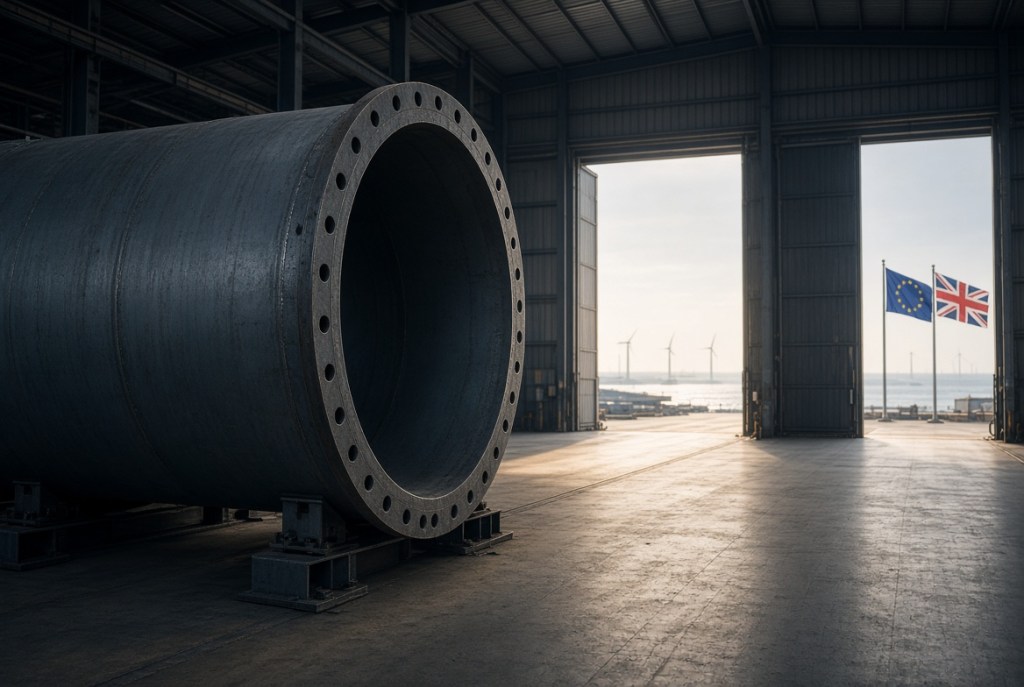
It is worth recalling a point I touched on in the first article: in the automotive compromise, the United Kingdom was included in the “Made in Europe” definition alongside the EU27 and the countries of the European Economic Area. Now the same country is moving to the position closest to the EU internal market on the carbon cost front as well. In other words, while a country that has left the EU is counted as “inside” on both main axes of industrial policy, Türkiye, a member of the Customs Union, remains a third country on both.
What does it mean for Türkiye’s wind industry?
It is possible to pass over this development by saying “it is an arrangement between two parties and does not concern us”; but for three reasons I do not think that is the right reading.
We mostly talk about CBAM as a matter for iron and steel, cement and aluminium producers. Yet the regulation’s list of goods includes steel structures under heading 7308, which covers towers, and the period of financial obligations has been running since 1 January 2026. In other words, a turbine tower shipped from Türkiye to the EU is a CBAM-covered product today. For nacelle and mechanical components the situation depends on the product’s customs tariff heading; but extending the scope towards downstream products is also on the agenda in Brussels.
The Turkish Emissions Trading System Regulation entered into force on 27 August 2026, and this is an important step. However, the pilot phase covers 2026–2027, there is only a reporting obligation in 2026, and all allowances are allocated free of charge. As long as no carbon price is actually paid, there is no amount that can be deducted from the CBAM obligation on the EU side. The UK example, meanwhile, shows that the road to exemption runs through a mature ETS that has achieved price convergence with the EU, and a linking agreement built on top of it.
The “trusted partner” definition is being written without us. In the second article, I discussed how the “you are either with us or with others” rhetoric in Brussels could be reflected in industrial files. This letter shows the sector-side counterpart of the same rhetoric: organisations including WindEurope and the turbine manufacturers who are our main customers are drawing the framework of trusted partnership in the clean technology supply chain around the EU and the United Kingdom. The letter of course has no intention of excluding Türkiye; but, as I underlined in the first article, nobody needs to target us specifically for us to be left outside. It is enough for the definition to be made without us.
The “Made in Europe” definition, the CBAM exemption and “trusted partner” status: in all three files the United Kingdom is inside, while Türkiye remains a third country.
So what can we do?
The “Made with Europe” approach I argued for in the previous two articles remains valid. This letter shows that the approach also needs to include a carbon heading. Once again, it may be useful to think in terms of three counterparts.
As industrialists, we need to see carbon data as a commercial requirement as basic as a quality certificate. For our tower manufacturers this is already today’s issue; it would be sensible for other component manufacturers, too, to build the infrastructure that can demonstrate, in a verifiable way, the embedded emissions of the steel they use and of their own processes, without waiting for the scope to be extended. In a market where the UK competitor will be exempt from this burden, being the supplier that can present its data quickly and reliably can close much of the gap.
As sector associations, this letter shows how broad a coalition European sector associations can build around a common text. The signatories include turbine manufacturers that produce in Türkiye or source from Türkiye. I am of the view that we should aim for a similar joint text to be written for Türkiye, so that Türkiye’s place in the European wind supply chain is explained to Brussels with the signatures of the same organisations. As I said in the second article, the most effective way is for European industrialists to come to demand us for the sake of their own security of supply.
From a public policy perspective: The fact that Türkiye’s ETS has been designed in line with the EU ETS is the right start. I think the next step is to clarify the timetable for the period after the pilot phase, and to add the goal of an ETS link with the EU as an explicit heading on the agenda for updating the Customs Union. The UK example shows that this road is long, but that it can be walked.
In place of a conclusion
In the first article of the series I asked “is wind next?”, and in the second I addressed the political dimension of that question. This letter adds a third dimension: Europe is deciding who counts as “inside” not only through the definition of origin, but also through attachment to its carbon market. As the United Kingdom opens these doors one by one, we need to ask ourselves which door we are waiting in front of, and how prepared we are for it. It is worth following the outcome of the 20 November summit with this in mind.
This article is a follow-up to “Automotive Has Fallen. Is Wind Next?” and “Is Wind Next? (II): You Are Either With Us or With Others”.

References:
- Joint industry letter calling for EU–UK ETS linkage and mutual CBAM exemptions ahead of the EU–UK summit — 47 signatories, 12 November 2026
- EU and UK set to link carbon markets in major post-Brexit deal — Euronews, 6 November 2026
https://www.euronews.com/2026/11/06/eu-and-uk-set-to-link-carbon-markets-in-major-post-brexit-deal - EU Close to Deal to Link UK Carbon Market After Brexit Split — Bloomberg / Energy Connects, November 2026
https://www.energyconnects.com/news/utilities/2026/november/eu-close-to-deal-to-link-uk-carbon-market-after-brexit-split/ - UK-EU Summit November 20: ETS Deal on the Table, CBAMs Unchanged — CBAM Guide, 12 October 2026
https://cbamguide.com/news/2026-10-12-uk-eu-summit-november-20-ets-link-uk-cbam/ - EU–UK ETS linkage: process overview — ICAP
https://icapcarbonaction.com/en/node/1093 - CBAM goods list (Regulation (EU) 2023/956, Annex I) — CBAM Guide
https://cbamguide.com/compliance/cbam-goods-list/ - Türkiye’s Carbon Market Board clarifies initial national ETS pilot design — ICAP, September 2026
https://icapcarbonaction.com/en/news/turkiyes-carbon-market-board-clarifies-initial-national-ets-pilot-design - Karbon geliri sertifika maliyetine dönüşebilir (in Turkish) — Dünya Gazetesi
https://www.dunya.com/surdurulebilir-dunya/karbon-geliri-sertifika-maliyetine-donusebilir-haberi-842535



Bir Cevap Yazın