Türkçe sürüm: Gerçek Yarış Karada Başlıyor: Deniz Üstü Rüzgâr Enerjisinde Sanayi Altyapısı
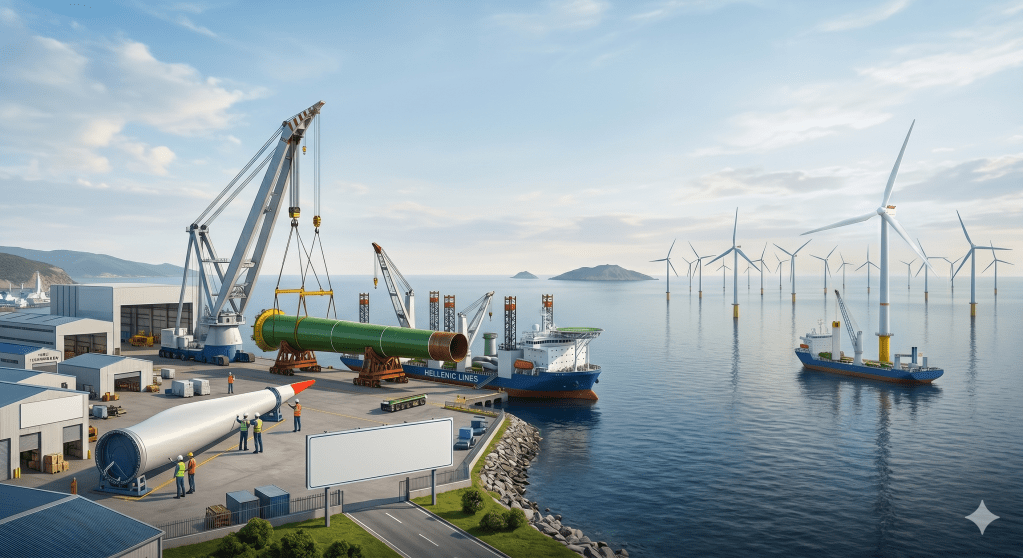
In May 2026, four sites off the Gulf of Saros, Gökçeada, Bozcaada and Edremit were declared Candidate YEKA (Renewable Energy Resource Areas) for offshore wind energy by Türkiye’s Ministry of Energy and Natural Resources. We all followed with great excitement and satisfaction this declaration, an important step towards the 5,000 MW of offshore capacity targeted by 2035, which will pave the way for our first offshore wind farm.
On the other hand, looking at it with my supplier’s hat on, what was truly exciting for me was not the size of the investments to be made, but the fact that for the first time we have come this close to the opportunity of building a manufacturing ecosystem to accompany this target. So, from where I stand, I believe the real race in offshore wind needs to start not at sea, but in our factories, ports and shipyards onshore.
Türkiye has today reached an installed capacity of more than 15,000 MW in onshore wind. I see the real achievement behind this figure, once again, on the manufacturing side: localisation in towers, blades and generators, and a sector memory that, together with dozens of local manufacturers of different scales and their sub-suppliers, has created direct employment for around 20,000 people.
Of course, this ecosystem did not come about by itself. The successfully designed and implemented YEKDEM mechanism, the local content requirements set in the YEKA competitions that followed, the incentives for locally manufactured components and a stable capacity allocation mechanism were the source of motivation for our industrial investors. Industrialists invested in capacity because they saw continuity of demand, and they continue to do so. Indeed, the new investments of ENERCON and Nordex Group Türkiye in İzmir can be read as precisely the latest link in this mechanism.
Under current conditions, however, it is not possible for now to assume that this success story written in onshore wind will repeat itself offshore. Perhaps the most important point we need to underline here is that, because of its physical dimensions, the offshore industry has completely different dynamics from the onshore industry and therefore requires different manufacturing technologies and competences.
Turbines are moving to ratings of 15 MW and above, and rotor diameters beyond 200 metres. It is reasonable to foresee that this scale will make most existing onshore production lines directly unusable. Foundation structures fixed to the seabed, such as monopiles and jackets, are components that require heavy steel construction and special welding technology, and that only a limited number of facilities in Türkiye can produce today. Just as critical as their production is their transport from shore to site and their installation. A local manufacturing ecosystem story without installation vessels with heavy lifting capacity, and without specialised ports with reinforced quays and storage areas, would be stillborn.
In other words, offshore wind means a supply chain stretching from raw materials to heavy industry, from shipbuilding to port infrastructure, far broader than onshore, and both labour-intensive and capital-intensive. For our country, the full half of the glass looks highly satisfying: Türkiye already has many of these competences. What is missing is the demand that will direct these scattered capabilities towards the offshore wind industry, and the coordination that follows.
It is clear that there is a real window of opportunity here for Turkish industry. Europe’s offshore supply chain is operating at its capacity limit; a global bottleneck in foundations, cables and installation services is constantly on the agenda. Türkiye has the potential to become a manufacturing base that both produces for its own domestic market and, with its geographical proximity and cost advantage, exports to projects in the Eastern Mediterranean, the Black Sea and Southern Europe.
But this window of opportunity is not permanent. Once Europe solves its own supply chain bottleneck, or another country in the region positions itself first, it is very likely that we will fall behind. We are therefore going through a critical period: the tender calendar, the tender terms and the manufacturing investment decisions we believe will be needed afterwards have to move forward simultaneously. What can be seen at this stage is that the industrial investor will, rightly, wait to see the details and the outcome of the tenders, while the energy investor who wins a tender, if unable to find a ready supplier, will see the resulting gap filled with imported components. This is exactly where the terms of the tender become far more important for building a healthy local ecosystem. Commercial terms that encourage the energy investor to use local equipment must be offered together with a calendar that allows the industrial investor to act. In any other scenario, building the local ecosystem will become much harder and more expensive. Naturally, we should set aside populist claims such as “100% local and national” and create an expectation that fits the infrastructure of our country’s manufacturing ecosystem and that encourages, rather than dampens, the appetite of our energy investors. Otherwise, the romantic rhetoric that comes with unrealistic localisation expectations will be a great loss for all parties.
We should set aside populist claims such as “100% local and national” and create an expectation that fits the infrastructure of our country’s manufacturing ecosystem and that encourages, rather than dampens, the appetite of our energy investors.
Another point of value for the industrialist, together with the incentive mechanism that will create the demand, is predictability. Considering the payback of a factory investment, no rational investor should be expected to enter into a heavy industry investment without reasonable confidence that demand will continue for at least 8 to 10 years.
Reaching 5,000 MW of offshore capacity is of course a national energy target of ours, and achieving it is technically possible under any conditions in which financing is secured. But creating a lasting offshore manufacturing industry, skilled employment and export capacity in Türkiye while installing those 5,000 MW will be our truly valuable and truly difficult test. If we succeed, writing a new success story with the economic value, employment and export capabilities created is not impossible. We have done this before in onshore wind; not by chance, but through the right policies and investor appetite. With a similar roadmap offshore, these tenders will not remain merely a matter of security of energy supply; they will lay the foundations of a new industry that will last for decades.
In short, I have boundless faith that our preparation at sea will create a value that multiplies onshore as well.





Bir Cevap Yazın