Türkçe sürüm: Sektör Raporu: Avrupa Rüzgar Enerjisinde Büyük Dönüşüm
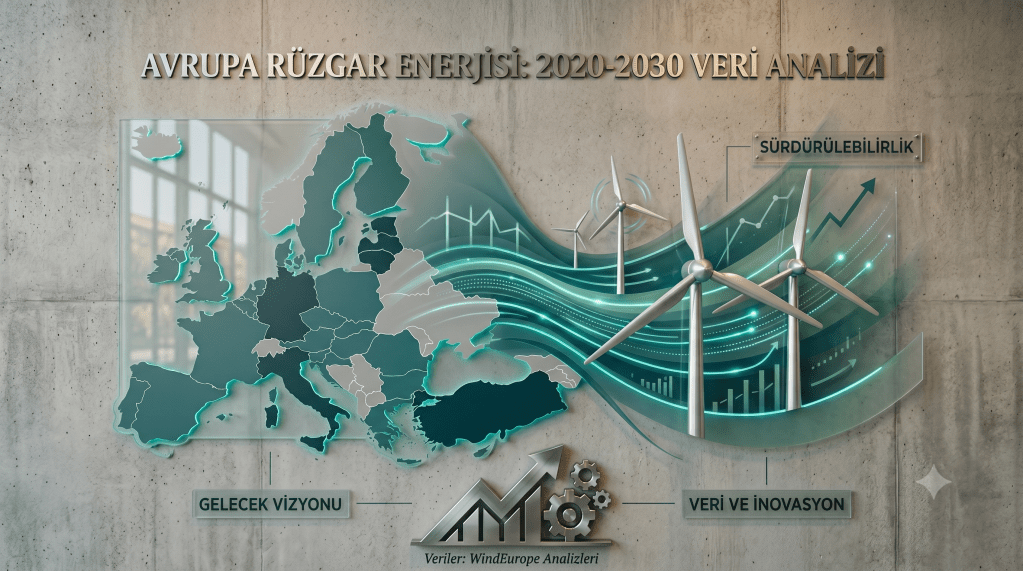
Looking at the data on Europe’s last five years in wind energy, it becomes strikingly clear how decisively and how quickly the choice for wind has been put into practice. Let us go through the figures I have compiled from WindEurope’s 2025 statistics and its 2026-2030 outlook:
304 GW: The EU Has Turned Its Face to the Wind
By the end of 2025, Europe’s total installed wind capacity had reached 304 GW; 265 GW of this is onshore and 39 GW offshore. The EU-27 countries alone account for 246 GW of capacity.
In 2025, 19.1 GW of new capacity was added in Europe; ninety per cent of these new installations were onshore wind turbines. Germany once again took the largest share, with 5.7 GW. Türkiye also made it into the upper ranks of this list: with 2.1 GW of new installations, Türkiye overtook Sweden and proved that it is one of Europe’s fastest-growing wind markets.
Investment Volume: EUR 45 Billion a Year
The capital flowing into wind energy is at least as remarkable as the capacity figures. In 2025, EUR 45 billion was invested in the construction of new wind farms in Europe; this amount was split almost equally between onshore and offshore.
In addition, the secondary market, covering project acquisitions and changes in ownership, saw EUR 19 billion of activity; projects amounting to 25 GW changed hands. This picture shows how lively and liquid an ecosystem the wind sector has become, not only at the construction stage but in the capital markets as well.
Another factor feeding the investment climate is the auction mechanisms: in 2025, 38 GW of projects were awarded in auctions across Europe — the highest annual auction volume of all time. Poland, Germany and the United Kingdom were the standout markets.
Half of the Electricity from Wind: The Danish Model
The share of wind energy in electricity consumption is becoming a yardstick by which countries measure their energy independence in real terms. According to the 2025 figures, Denmark meets 50% of its electricity from wind, the highest share in the world. Lithuania and Ireland follow with 33%, the United Kingdom with 31% and Sweden with 30%. With the Netherlands at 29%, Germany at 28%, Finland and Portugal at 25%, Spain at 23% and Greece at 21%, these countries have joined the club of countries “where wind runs the electricity”.
These data document not only a technical achievement but also the change of mindset taking place in energy sovereignty. Dependence on fossil fuel imports is decreasing with the transition to wind energy.
Offshore: Strategic Growth
Offshore wind had a relatively modest year in 2025: a total of 2 GW and 184 new turbines were installed, and 5 new wind farms were commissioned. At present 6,776 offshore turbines are operating in 13 countries, with a total capacity of 38.6 GW. The United Kingdom maintains its lead in this field; Hornsea Two (1,386 MW) and Hornsea 1 (1,218 MW) retain their titles as the world’s largest offshore wind farms.
The real message behind the slow growth figures, however, concerns the future: construction is under way on more than 20 wind farms, and more than 10 others are about to start. This means 25 GW of offshore wind capacity within the next three years.
The 2030 Target: 439 GW and 607,000 Jobs
WindEurope’s projection models foresee Europe installing 151 GW of new wind capacity in the 2026-2030 period. If this materialises, total capacity will rise to 439 GW, and the EU-27’s share will reach 343 GW. The target of 22 GW of installations a year on average requires a pace roughly fifty per cent above the current rate.
The wind sector in Europe today provides direct or indirect employment for around 443,000 people. By 2030 this number is expected to rise to 607,000. In other words, wind energy is transforming not only the climate but the labour market as well.

Data: WindEurope, “Wind energy in Europe: 2025 Statistics and the outlook for 2026-2030” (February 2026); “Offshore wind in Europe – key trends and statistics 2025” (March 2026); “Financing & investment trends 2025” (April 2026); Interactive Data & Maps platform.



Bir Cevap Yazın